Verification pays: How IMI Global helps producers earn premiums and future-proof their operations
By Mark Johnson
When Doug Stanton joined IMI Global, now Where Food Comes From, Inc. (WFCF), nearly two decades ago, third-party livestock verification was still a niche concept. Today, it’s a business imperative for forward-thinking cattle producers seeking access to premium markets, export opportunities, and long-term resilience.
“We help ranchers get paid for doing the right thing,” says Stanton, who leads sales and business development from IMI's Castle Rock, Colorado, office.
Celebrating its 30th year in 2025, IMI Global was founded by John and Leann Saunders in 1995 and has grown into a national leader in agricultural verification. The company changed its name to Where Food Comes From, Inc. in 2006 to better reflect what is really does.
The company’s impact reaches well beyond cattle, but beef remains its core business. IMI's programs serve as a bridge between producers and packers, enabling verifiable claims that buyers trust and consumers increasingly demand. LiveAg is proud to welcome IMI Global/WFCF as a strategic partner.
From one cow to a national standard
The spark that launched IMI’s verification focus came in 2003 with the U.S. outbreak (one cow) of bovine spongiform encephalopathy (BSE).
"When Japan shut its doors to U.S. beef because of that event, we needed a way to prove our product was safe," Stanton recalls. “The only way we could get back into that market was to verify that the product going to Japan was under 20 months of age, because Japan then felt comfortable that that product would be free of BSE.”
IMI responded with the first USDA Process Verified Program (PVP) for Source and Age Verification, enabling access to that crucial export market.
From there, the portfolio expanded. In addition to the Source and Age Verification, LiveAg is partnering with IMI Global/ WFCF with other programs, including Non-Hormone Treated Cattle (NHTC), Verified Natural Beef, CARE Certified, Verified Grass-fed, Breed Verification opportunities, Non-GMO Project and AngusLink Genetic Merit ScorecardSM. Stanton says IMI encourages producers to “bundle” programs for maximum market flexibility.
“Some buyers want Natural, some want NHTC, others need CARE,” he says. “If your operation carries multiple claims, you have more opportunities.”
How it works
When a producer expresses interest in enrolling with IMI Global/ WFCF, the process begins with an application and pre-screening.
“Generally, the new applicant provides us with information about their operation that we evaluate to determine where they are today,” Stanton explains. “We’ll ask for information about the feed products that they're feeding, whether they’ve implanted the calves, fed them some product that may have an antibiotic in it, or treated some calves but not identified them. Things like that are quick indicators to us as to which of our programs they may or may not qualify for.”
If the operation looks like a fit, an annual on-site verification is scheduled.
“We verify things like date of birth records, head count, feed sources, treatment records, , and pasture conditions,” Stanton explains. “If they'd also like to add our sustainability platform CARE — and because there's environmental and animal welfare elements involved in that program — we would also look at facilities, the pasture, the cows themselves for body condition, and things like that. There's a host of elements that come into play when a producer also selects the CARE program, and we bundle that into one onsite visit on an annual basis.”
CARE verifications also evaluate environmental stewardship and community involvement. Uniquely, CARE is a scored program, allowing producers to gradually improve performance year over year.
“It’s a journey, not a pass/fail type of thing,” says Stanton. “And we provide them with resources to help get them there.
What it costs — and pays
Verification isn’t free, but the return on investment can be significant. Take, for example, a 200-head cow/calf operation. If that producer markets two truckloads of calves annually, the average total costs for IMI’s bundled services are around $15 per head, including the verification, travel, EID tags, and enrollment.
"We estimate the premium from selling verified cattle at about $90 a head," says Stanton, citing data from video auction platforms and USDA comparisons. "That’s a $75 net gain per animal."
Most of that value comes from access to video auctions like those provided by LiveAg, where buyers seek program cattle and know that a third-party verification backs the claims.
Stanton adds that local sale barns may not be approved for program cattle, and that can cost producers money.
“If a producer runs them through a non-approved sale barn, they end up losing that value,” he warns. “You definitely want to do your homework ahead of time.”
Despite the obvious upside, only an estimated 15% of U.S. beef cattle currently move through verified programs. Why? Common barriers include implants, lack of calving records, inconsistent management practices, or simply a low headcount that doesn’t justify fixed verification costs. Still, even small producers can benefit if they align with others or market strategically.
“Verification turns good management into more dollars,” Stanton points out. “You’re not just selling cattle — you’re selling a story, a third party verified standard, and a promise.”
‘The right thing to do’
Susan Hart, co-owner of Hart Ranch in Little Shasta, California — just south of the Oregon border — says that she and husband Blair have been enthusiastic participants of IMI Global’s third-party verification programs for more than 15 years and can’t imagine marketing their cattle without them.
“When people buy our cattle, we want to ensure that we have everything documented and verifiable,” says Hart. “From the beginning, we intended to provide the best product, and to do that, we wanted to find an organization that was not only good at what they do as far as auditing and managing the programs, but also on the cutting edge in the cattle industry. IMI Global realizes that it's not only the quality of the beef or the product, but it's also how the cattle are raised that speaks to not only the care of the animals, but the sustainability of the range that the cattle run on. We're constantly working to enhance those conditions.”
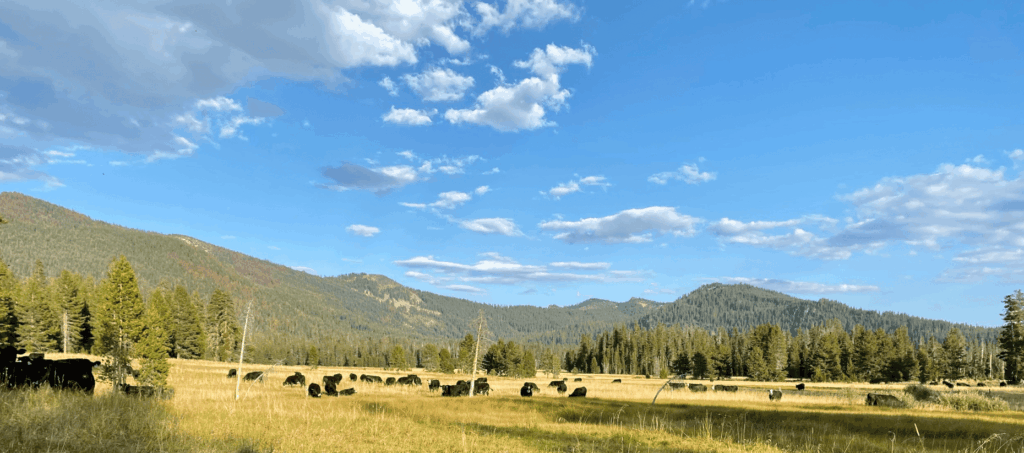
The sixth-generation Angus ranch, which grazes around 650 mama cows, is certified via IMI Global/ WFCF for programs including Where Food Comes From – Care Certified,, NHTC, USDA Age & Source Verified, Beef Quality Assurance, AngusVerified and Genetic Merit Scorecard, and Herd BVD-Pi screened Negative. Hart points out that while the process of becoming verified in these areas can be time-consuming, the result is well worth the effort.
“IMI looks at not only the needs of the producers, but also the consumers,” she notes. “They have an open-door policy with respect to ideas, because they recognize that every region and customer brings new opportunities and maybe has different needs — and they're very willing to address those. It gives us a huge peace-of-mind to know that our hard work and attention to detail are both being rewarded and helping to improve our industry.”
Hart, whose daughter, Alex, and nephew, Zach Salvestro, also work the ranch, says IMI’s certifications are “another way of putting your money where your mouth is.”
“We don’t enroll in these programs to get brownie points — we do it because it's the right thing to do,” she says. “In return, the market also recognizes that it’s the right thing to do. People want healthy food, and what better way than to buy American-raised, certified-verified beef? We view IMI as a partner to help us market our cattle with the expectation that the buyer is going to pay more for our products — and they do.”
Hart adds that she considers IMI Global/ WFCF to be part of a “three-legged stool of success.”
“You've got your third-party verification, your producer, and your sales team,” she says. “It's all part of one package. In addition, IMI also works with our seedstock producer, which brings in yet another level of transparency. We’re all one big family.”
A future built on trust
As consumers grow more concerned with food origin, animal welfare, and environmental impact, transparency for high-quality producers like Hart Ranch is becoming a requirement. IMI Global’s/ WFCF alignments with breed associations like Angus, Charolais, and Hereford, along with forward-thinking companies like LiveAg, position it well for the future.
"Where Food Comes From isn’t just our name — it’s our mission," says Stanton. “Transparency is top of today’s consumer’s mind, and they are wanting to know more and more about their food and where it's coming from. We feel that we’re situated very well for the future of transparency and of being able to tell the consumer where their food does come from — it's the name of our company and what we do every day. We started 20 years ago with Source and Age Verification, which then evolved into our other programs, and I think there will be additional claims down the road that will result from consumer demand and what they're wanting to validate on a product. Consumers expect to see the labels and make sure that there is third-party oversight, simple as that.”
With LiveAg’s trusted video platform expanding, the synergy between verifier and marketer has never been more critical.
For more information about IMI Global/ Where Food Comes From, Inc., visit www.imiglobal.com.